Thomas Schirrmacher
ArchiveGeoff Tunnicliffe

Pope Francis, further reflections

April 17, 2013 by Schirrmacher · Leave a Comment 

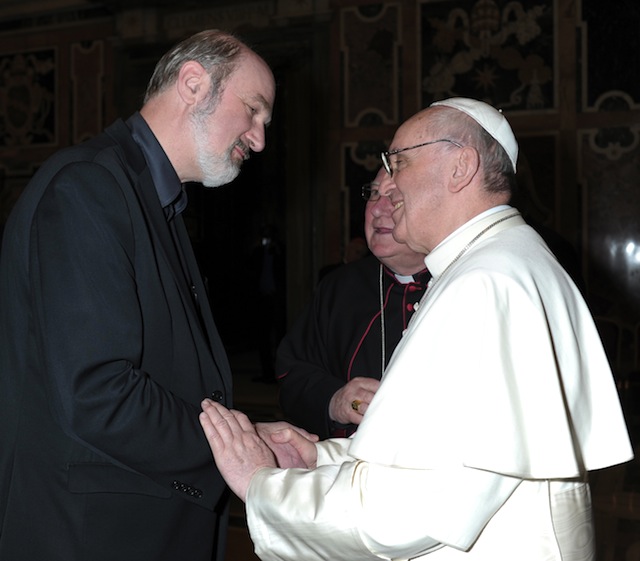
After my participation at the inauguration of the Pope and my short conversation with the Pope the following day (which was carried live on Italian television and was also broadcast by Phoenix in German), I was interviewed by several media outlets. I also gave some exclusive statements which were referenced by the German and English media:

I was now asked to make those exclusive statements accessible. The following are English translations of my press statements from March 21, 2013:

The Pope has initiated significant changes, of course largely symbolic at first, which directly relate to other churches. The fact that he openly welcomed the representatives of churches, using the word “church” without further ado, in his inaugural worship service, was a clear break with centuries of tradition, even if the claims of the Vatican declaration “Dominus Iesus” were not set aside. At his official audience with representatives of other churches, he abandoned the traditional red and gold papal throne, which was standing in a nearby room, and even abandoned the tradition of using a chair raised a couple steps above the surrounding floor. He even called the Ecumenical Patriarch “brother.” His affirmation of ecumenical cooperation and of the necessity of continuing discussion of theological agreements and differences was more pointed than has ever been formulated and clearly came from his heart.

© L’Osservatore Romano

© L’Osservatore Romano

As everyone could see from the live broadcast, his reception of Geoff Tunnicliffe, General Secretary of the World Evangelical Alliance, equally came from his heart, as did his greeting for me. The Pope knew exactly whom he was receiving, indicating it is completely alien to him to see evangelicals as a kind of Christian to be treated differently than other Christians are treated.

In my short discussion, I recommended to the Pope to take up the theme of Christian persecution more energetically and to give this concern an institutional home in the structure of the Vatican, which seemed to evoke a positive response. Already in his role as Archbishop, the Pope repeatedly stood behind support for evangelicals who were imprisoned on account of the faith. I hope for real progress in this arena.

As representatives of the World Evangelical Alliance, we held many discussions, in addition to those with the Pope. I spoke with German politicians who came to the papal inauguration as well as with the German cardinals and bishops who attended. I met eleven other cardinals and dozens of staff members of Vatican committees, as well as holding informal and official discussions with several guests from both Protestant and Orthodox churches. Among these were the Ecumenical Patriarch of Constantinople and other patriarchs, archbishops, and general secretaries. For those from the German situation, where the free churches and the evangelical alliance have had only limited constructive contact with the old churches, it is surprising and pleasant that the World Evangelical Alliance is properly received in Rome and Geneva as representing 600 million Christians. This is not the result of any theological changes on the part of evangelicals, which no one expects from us, but results entirely from the existence and size of the evangelical movement.

Within the Vatican there is an optimist mood, which we saw in numerous discussions. Of course the Pope will have to implement his words and symbolic gestures in action, but he is trusted to activate the process of “desecularizing” the church, proclaimed by Benedict XVI, by means of energetically addressing the problems within the Curia, including every type of double morality and especially the problems of sexual abuse.

Impressive thanksgiving service for John Stott in St. Paul’s Cathedral

April 10, 2012 by Schirrmacher · Leave a Comment 

Pictures, reports, press releases

© Langham Partnership

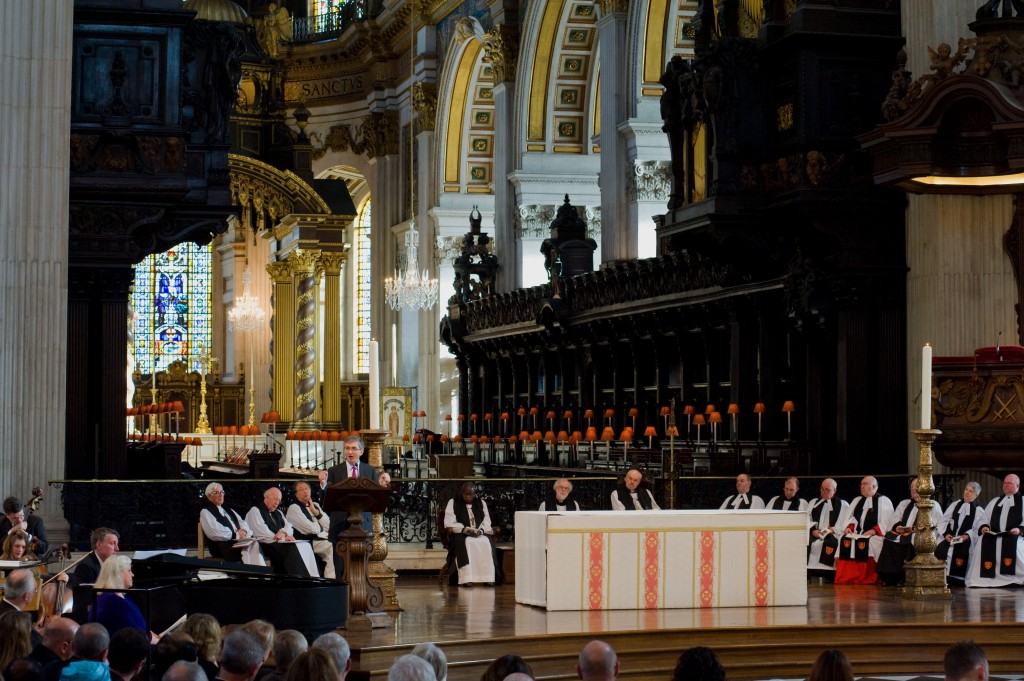
2000 invited guests from all over the world attended the “Service of Thanksgiving for the Life of John W. Stott” in London’s St. Paul’s Cathedral. I never saw so many Anglican and other bishops attending the farewell service of a simple priest. It was one of the most impressive services I ever visited and “The Cross” – the title of Stott’s major work, stood in the center of it.

Says S. Douglas Birdsall, chair of the Lausanne Movement: „I travelled to London this week from my home in Boston, US, for the memorial service for John Stott. The Apostle Paul was his mentor, through the pages of scripture, so St Paul’s Cathedral had a symbolic ring as a choice of venue. Stott shared with the Apostle both a sharp intellect and a deep and driven passion for the Christian gospel.” (see more of him here: http://www.lausanne.org/en/blog/1757-portrait-of-a-christian-leader.html).

The service sheet included tributes by Billy Graham, the chairman and the international director of The Lausanne Movement, S. Douglas Birdsall and Lindsay Brown, and the Secretary General of WEA and the Chair of the Theological Commission of WEA Geoff Tunnicliffe and Thomas Schirrmacher.

Download: WEA contribution

Download: Full service sheet

See also my tribute to John Stott here.

Reports on the service

Official report by Chris Wright, International Director, Langahm Partnership:
website: http://www.johnstottministries.org/news/264
as file: http://www.johnstottmemorial.org/resources/press/stpauls-press-release.doc

British Alliance: http://www.eauk.org/articles/john-stott-memorial-service.cfm

Speeches: http://www.johnstottmemorial.org/media/

Youtube:

http://www.johnstottmemorial.org/media/

On John Stott:

http://www.eauk.org/articles/the-world-pays-tribute-to-john-stott.cfm

http://www.johnstottmemorial.org/media-resources/

© Thomas Schirrmacher

Press release by the Evangelical Alliance of the United Kingdom

Hundreds packed out St Paul’s Cathedral in the heart of the city of London on Friday to celebrate the life of John Stott – one of the 20th century’s leading evangelical thinkers – who died in July, aged 90.

Staff from the Evangelical Alliance, including General Director Steve Clifford, were among 2,000 people who joined Rev Stott’s closest friends and colleagues, as well as the Archbishops of Canterbury and York and the Bishop of London, at the memorial service.

In a touching event including music from the All Souls Orchestra and tributes by Christians from across the globe, the congregation heard how many lives had been touched by the teaching, writing and friendship of the man affectionately known as ‘Uncle John’.

Opening the service, Canon Mark Oakley of St Paul’s said: “We come to this cathedral church today to give thanks for the life of a humble and faithful servant of Jesus Christ. We remember with joy and thanksgiving John Robert Walmsley Stott, a minister of the gospel, beloved pastor, Bible scholar, mentor and friend.

“His simple life of study and prayer, preaching, writing and discipling, helped shape the face of a 20th century evangelical faith in Britain and around the world. He was valiant for truth, even when that was unfashionable, and single-minded as he laboured to fulfil the Lord’s call upon his life.

“John eschewed public accolades and ecclesiastical preferment and would be embarrassed by any service that dwelt on him or his achievements rather than pointing to his Saviour, crucified, risen and ascended.”

Reflecting on the service, Steve Clifford said: “John Stott lived his life simply as a follower of Christ. The celebration at St Paul’s Cathedral gathered the Christian community from right around the world.

“We may never know the full impact of his life through his writing and preaching but when the history of evangelicalism in the past century has been written, John Stott will be recognised as a giant of the faith.”

Born in 1921 in London, John Stott was a member of All Souls Church, Langham Place, all his life. Among his most celebrated writings were Basic Christianity and The Radical Disciple. He served as one of the Queen’s Chaplains and was awarded a CBE in the Queen’s New Year’s Honours list in 2005 – the same year he was named in Time magazine’s top 100 most influential people.

Despite his accolades and influence, those who knew him described his humility and his dedication to seeing Jesus glorified above all else – both in the Church and society as a whole.

Rene Padilla, founder of The Kairos Centre, in Buenos Aires, Argentina, said: “There is no exaggeration… in my” saying that the aspect of John’s legacy that I treasure more than anything else is his Christian character. He was a man who could say with the apostle Paul, without any hesitation: ‘Be imitators of me, as I am of Christ’. I am not surprised that the very last book John wrote was The Radical Disciple. That is what he was: a radical disciple of the Lord Jesus Christ, a disciple who in his character and lifestyle embodied God’s purpose for human life.”

Paying tribute, Geoff Tunnicliffe, secretary general of the World Evangelical Alliance (WEA), said: “Although many of the 600 million evangelical Christians may never have heard of John Stott, almost without exception they will have been unconsciously influenced through what they or their pastors have read from his pen. The whole of the leadership of the WEA acknowledges with great thankfulness to God the legacy that John Stott has left behind to encourage and guide us.”

Thomas Schirrmacher, Chair of the Theological Commission of WEA added: “I hope that the Theological Commission of the World Evangelical Alliance can maintain these high standards for the future and carry on Stott’s theological heritage into the future of the evangelical movement.”

© Kieran Dodds

Chris Wright: Memorial and Thanksgiving Service for John Stott St Pauls’s Cathedral, 13th January 2012

A life that still speaks; a vision that inspires.

The majestic stone columns and arches of St. Paul’s Cathedral glowed in the honeyed light of the winter sunshine, while Christopher Wren’s great dome resounded to the music of organ, orchestra, choir and two thousand voices giving glory to God in thanksgiving for the life and ministry of Rev Dr John R. W. Stott (1921-2011). The service was held on Friday January 13th, 2012 and drew people from the corners of the UK and many parts of the world.

Music for the service was led and arranged by Dr Noel Tredinnick with the All Souls Orchestra and a gathered choir, along with soloist Elisabeth Crocker. The hymns, some of which were chosen in advance by John Stott, included ‘Sing to God new songs of worship’, written by Bishop Michael Baughen who presided, and ‘Lord for the years’, written by Bishop Timothy Dudley-Smith, who preached. The service opened with a welcome and bidding by Canon Mark Oakley, Canon in Residence at St. Paul’s.

Tributes began with Frances Whitehead, John Stott’s secretary for 55 years, who was converted to Christ through his preaching and thanked God for his life – marked to its very end by faith, hope and love, along with grace and truth. Stott’s global influenced was recognized in tributes brought from Asia, Africa and Latin America by, respectively, Archbishop John Chew (Singapore), Bishop Robert Aboagye-Mensah (Ghana), and Ruth Padilla DeBorst (Costa Rica). All spoke of the influence in their continents of his life and friendship, as well as his teaching. Ruth Padilla DeBorst stressed how Stott had listened so deeply to his friends and allowed the realities of poverty and injustice in Latin America to stretch, challenge and inform his own worldview and his understanding of the scope of gospel mission.

In his sermon, Timothy Dudley-Smith, one of Stott’s oldest friends since their student days at Cambridge, preached from Revelation 17:14, where those who are with Jesus are described as ‘Called, chosen and faithful’ – words that he illustrated from Stott’s life, while challenging all present to answer the question that Stott himself would ask, ‘How is it between you and Jesus?’ He recalled John’s sermon at the re-opening of All Souls church in which he had said he ‘dreamed’, among other things, of a serving church that would be salt and light in society.

That theme was picked up by Mark Greene and Chris Wright who presented the ongoing vision that is embodied in the two organizations that they lead and which, at Stott’s request, will benefit jointly from The John Stott Memorial Fund – respectively, the London Institute for Contemporary Christianity and the Langham Partnership International. Greene pointed to Stott’s passion that lay Christians should be the agents of the gospel’s transforming power in the frontlines of their places of work, but lamented that this part of Stott’s vision had not been truly grasped or implemented in whole-life disciple-making. As a result, even though there are more Christians in the City of London than in the tents outside the Cathedral, the salt had not been doing its job. Wright pointed to Stott’s complementary passion that, for Christians to be such transformative salt and light in the world, they need the nourishment of applied Bible preaching by pastors who are committed and trained to provide it.

Prayers of thanksgiving after the tributes were led by Bishop Michael Baughen, and prayers of commitment after the sermon and ongoing vision were led by Judge David Turner. Closing prayers were led by John Sentamu, Archbishop of York, and Richard Chartres, Bishop of London, and the blessing was pronounced by Rowan Williams, Archbishop of Canterbury.

As the echoes of the last lines of the final hymn resounded among the sunlit stone vaults of the vast Cathedral spaces — ‘Past put behind us, for the future take us / Lord of the years, to live for Christ alone’ –  two hundred and fifty miles away another stone stands surrounded only by the music of the sea and sky. A gravestone of rough-hewn Welsh slate now marks the spot in the tiny village cemetery of Dale, Pembrokeshire, Wales, where John Stott’s ashes lie buried. Like the man himself – slender, upright, rooted in the earth but pointing to the heavens – it is inscribed with his own words:

Buried here are the ashes of John R. W. Stott …
who resolved both as the ground of his salvation
and as the subject of his ministry
to know nothing except
Jesus Christ and him crucified.
1 Corinthians 2:2

Chris Wright, International Director, Langham Partnership International

International Journal for Religious Freedom Accredited

Februar 27, 2012 by Schirrmacher · Leave a Comment 

South African Department for Higher Education and Training put IJRF on the list of approved journals

(Cape Town/Bonn, Bonner Querschnitte News 196 – No. 02/2012) The International Journal for Religious Freedom (IJRF) has been included in the “Approved list of South African journals” effective as from 1 January 2012.

Prof. Dr. Christof Sauer as the editor in chief of the journal reports: “The Department of Higher Education and Training of the South African government, which administers this list, has just communicated the acceptance of IJRF on this list. We have been striving for this sought after accreditation since the founding of the journal in 2008. The criteria are very stringent and it is difficult to obtain”.

“In South Africa the recognition of a scholarly journal by the government is crucial for the status of a journal”, Sauer explains. “State subsidies for universities are partly based on the number of articles published by its academics in approved journals. So South African scholars usually prefer to publish in accredited journals.”

The issues of the IJRF were assessed by both the government department and the Academy of Science in South Africa (ASSAf) according to the National Code of Best Practice in Editorial Discretion and Peer Review for South African Scholarly Journals.

The IJRF aims to provide a platform for scholarly discourse on religious freedom in general, and the persecution of Christians in particular. The IJRF is an interdisciplinary, international, peer reviewed journal, serving the dissemination of new research on religious freedom and is envisaged to become a premier  publishing location for research articles, documentation, book reviews, academic news and other relevant items on the issue.

The IJRF which appears twice a year is published by the International Institute for Religious Freedom (Bonn – Cape Town – Colombo) of the World Evangelical Alliance. The editors are Prof. Dr Christof Sauer (Cape Town) and Prof. Dr Dr Thomas Schirrmacher (Bonn). Prof. Stephen Baskerville (Washington D.C.) is currently the managing editor.

The journal is available for subscription as a print version and made freely available online with a delay on 1 March and 1 September respectively (www.iirf.eu). The IJRF is also included in the portfolio of the provider of electronic journals for libraries, SABINET.

A recent issue on “Advocacy and Law” was widely distributed on 4 continents by Advocates International and a number of other sponsors. The latest issue deals with “Religion and Civil Society”.

Downloads and Links

Thomas Schirrmacher